Do you need an audience before you launch a crowdfunding campaign? The answer is a little more complicated than a yes or no. Here I share how I successfully crowdfunded my first graphic novel without a large social media following… and share the data behind it.
First, who am I?
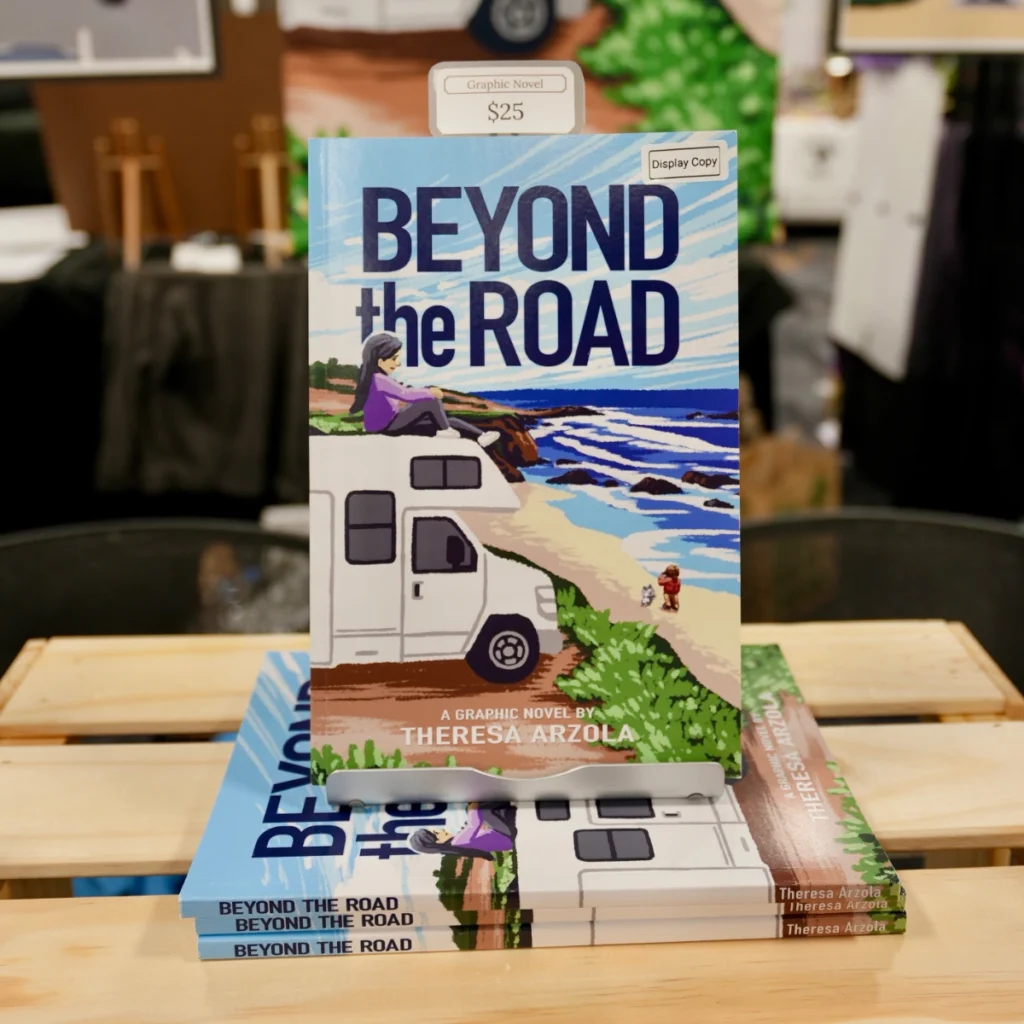
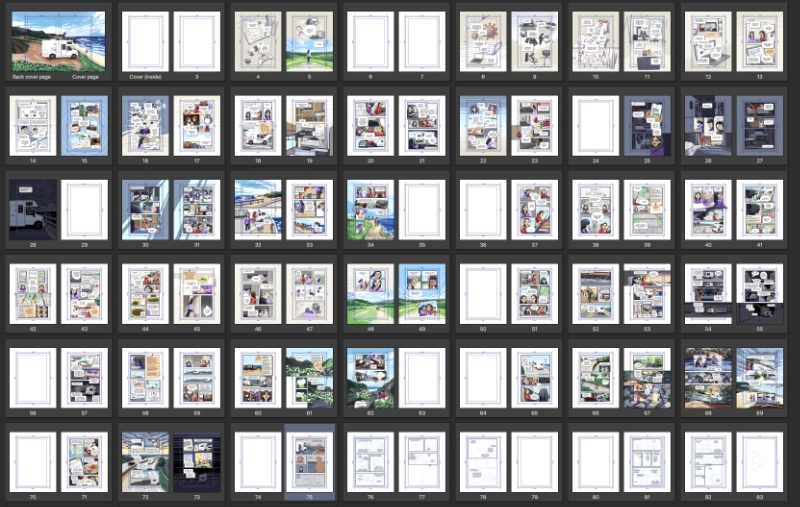
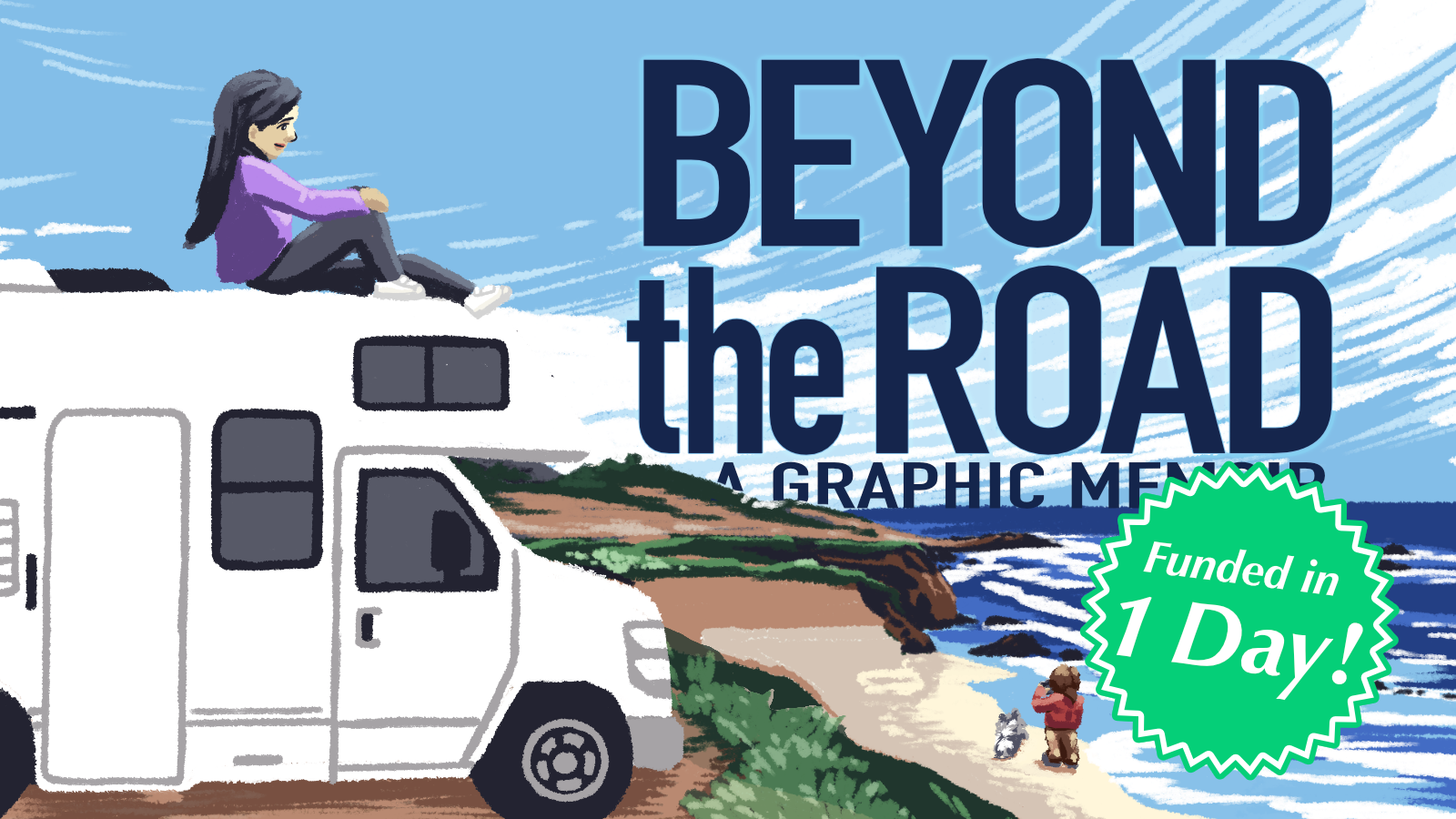
I’m Theresa Chen Arzola. I am the creator of Beyond the Road, a true story graphic novel memoir about a road trip and perseverance through chronic health issues. At 110-pages of full-color panels and spreads, the book’s 1st print run was successfully funded via Kickstarter in early 2026, a campaign I ran completely on my own as a small-scale indie graphic novelist.
I also happen to be a UX designer with over 10 years of industry experience under my belt. I can’t help but collect data and look for patterns. During my crowdfunding campaign, I kept a lot of records in order to analyze the results. Here’s what I found.
Debunking the myth
Everyone asks, “do I need an audience first?” because they’ve heard the viral underdog story: A lone individual or a small team, creating something magical in isolation, finally posts that project on a crowdfunding website, only to have it go viral, raising hundreds of thousands of dollars (or millions in some cases), launching them into fame and fortune through the magical power of virtual word-of-mouth.
Unfortunately, this story is a facade. Aspirational, but not realistic. Viral crowdfunded projects usually have a campaign strategy and a paid marketing team behind them. The story of their unexpected success is part of the campaign. And yes, you will find campaign owners who are genuinely shocked at the response they receive, but the possibility of viral success was always on some team member’s radar. Critical Role had millions of followers before their Kickstarter campaigns. Good Omens was already a beloved book before kickstarting their Graphic Novel version. Iron Circus Comics, a small press comics publisher, had a long history of successfully running Kickstarters since 2015.
Chances are, if you’re here, you’re a small-scale indie creator. You’re not aiming to run a 6-figure crowdfunding campaign like the above, and don’t need the audience sizes they already had. But you still need an audience. The good news is you probably already have a good one.
Here’s my story
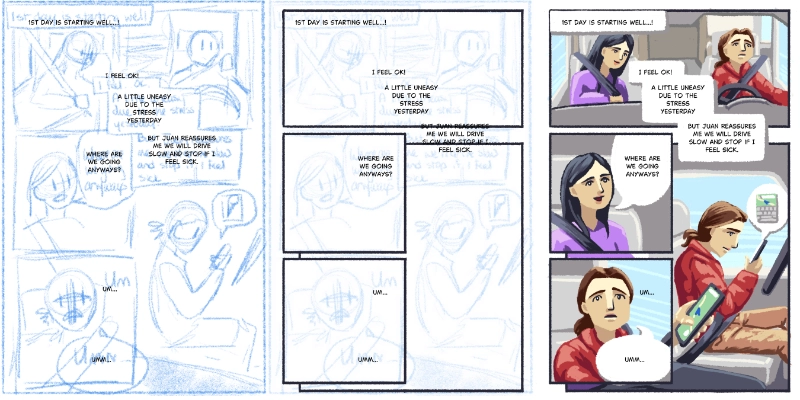
Beyond the Road took me 1 year to create (you can read about that process here: Beyond the Road: How It Was Made) and about 3 months to crowdfund. It started with research, looking into strategy, process, platforms, and tools. Hint: the internet is FLOODED with websites and 3rd party tools. So many, in fact, that the real information you need is buried in lead generation and search engine optimized articles.
My plan at the end of the research was this: use Kickstarter, do a soft announce 3 weeks before pre-launch, pre-launch on January 7 and network/spread the word/ask for follows for 3 weeks, then launch and run the campaign for another 3 weeks, promoting and communicating updates until it ends.
Why 3 week intervals?
The internet is full of contradicting advice on duration. Too short and you won’t give your followers enough time to discover and commit any funds. Too long and the campaign will run out of momentum long before the end date. I’ve seen sites recommend campaigns run as long as 2 months and as short as 2 weeks! The thing is, the 2-month campaign is for the larger projects, people using Kickstarter not because they necessarily need the funds, but because they are using it as a pre-order/marketing platform. 2 weeks is for the small-scale projects, who honestly just need the requested funds and don’t plan any more than that.
3 weeks was closer to that 2-week model, with a little wiggle room. But honestly? It was just psychologically easier to manage. In a 3 week period, you can break down your “marketing modes” by the week. Week 1: launch promotion. Week 2: Steady updates. Week 3: final push before the end.
Soft announce phase
In mid-late December I shared news that I was intending to launch a crowdfunding campaign to help fund the 1st print run of Beyond the Road. This “soft announce” was shared casually via my Newsletter and socials, particularly Facebook and LinkedIn, where my family, friends, and work friends still lurk. The intention wasn’t to push people to support just yet. It was a warming up of my social feeds, re-activating that authentic interaction with people through social media. Anyone who commented, I responded. Anyone who asked questions, I answered.
Prelaunch phase
Kickstarter, the platform I chose, had a “prelaunch” setup, a page you put up with limited information, meant to draw follows so that when the campaign launches, you’d have a batch of people ready to back the project as soon as it goes live.
I announced the pre-launch page, informing the channels I had warmed up earlier that follows helped the algorithm surface my Kickstarter to more users. I also directly pinged certain individuals and friends groups that I believed would not mind the direct ask.
Over the course of the 3-week pre-launch period, I started reaching out further to other groups. Comic creators who band together around crowdfunding platforms are eager to support. And dedicated research and networking lead to some interesting niche groups, such as the Graphic Medicine community (a sub-genre of comics focused on health-related topics… honestly, there’s some really cool stories highlighted through that org).
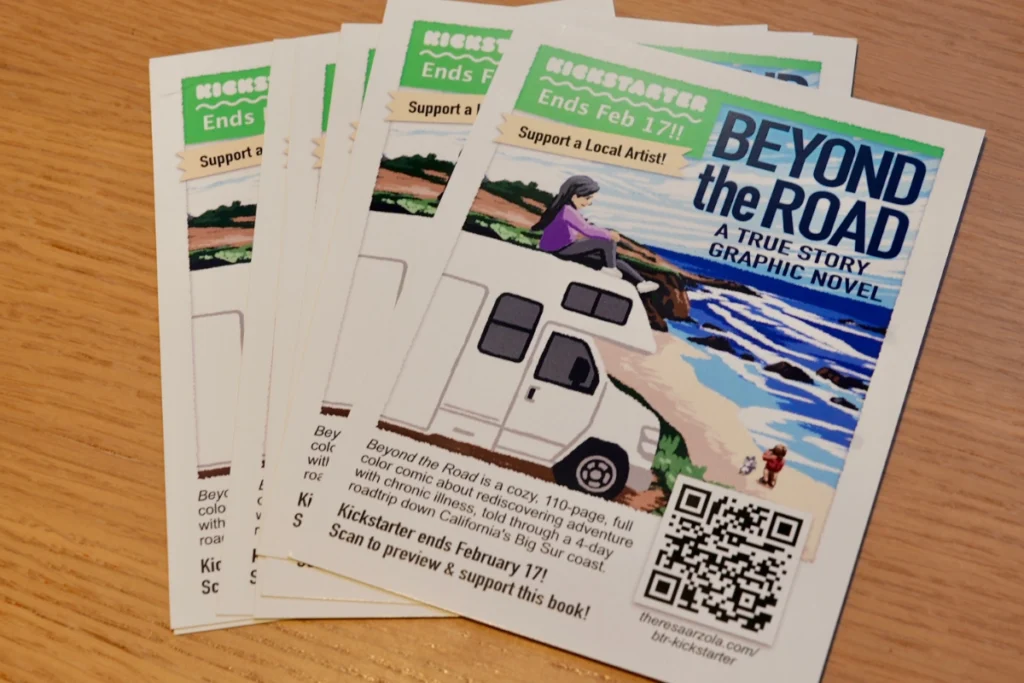
I even went as far as printing out $60 in postcards to leave at brick-and-mortar bookstores and comic shops in the Bay Area. This was, TBH, the most energy-burning effort with the least trackable returns. I really enjoyed visiting the store owners though and appreciated their encouragement!
Whether increased pre-launch follower count actually helps your crowdfunding campaign is kind of unknown. There’s a lot of theories, and a lot of suggested math around the predictability of a campaign’s success based on follower count (“20% of your followers will convert to backers”, etc). Kickstarter does not show you who follows and who doesn’t, so this math is not even possible to reliably calculate. I’ve heard other platforms do show this data though, so your mileage may vary. However, outreach before the launch is always a good thing and asking someone to click a free button is far less of a hurdle than asking them to contribute money.
Crowdfunding campaign phase:
The day of the launch, January 28, was “go” day. Messages went out, the newsletter released, and the social media call-outs and group chats were all individually posted. According to Kickstarter (and nearly all the 3rd party advice channels), the 1st 24 hours of the campaign matter. A surge of backers signals to Kickstarter that you are a potential candidate for “Projects We Love”. Getting on that list gets you more exposure…. Or so they say. TBH… the criteria seems internal to the company and maybe not as algorithmic as people think.
Within the 1st 24 hours, Beyond the Road’s Kickstarter was fully backed. For the rest of the 3 weeks, it was mostly sharing sneak peeks, talking about the story and the comic making process, and sharing status updates and stretch goal achievements on social media. By the end of the 3 weeks, Beyond the Road had hit $3195, 214% of its goal amount!
So let’s break that down.
Looking at the numbers
My Kickstarter ended with 74 backers at $3195. That’s ~$43 per backer, which is high, considering a pledge for 1 physical book was $22 and 1 signed book was $25. In truth there were a couple of “whales” hidden in that number (people who put in a much higher order than the others via add-ons) and the total number of physical books purchased was more accurately 88.
For more context, here are the Reward Tiers I offered as part of my Kickstarter campaign:
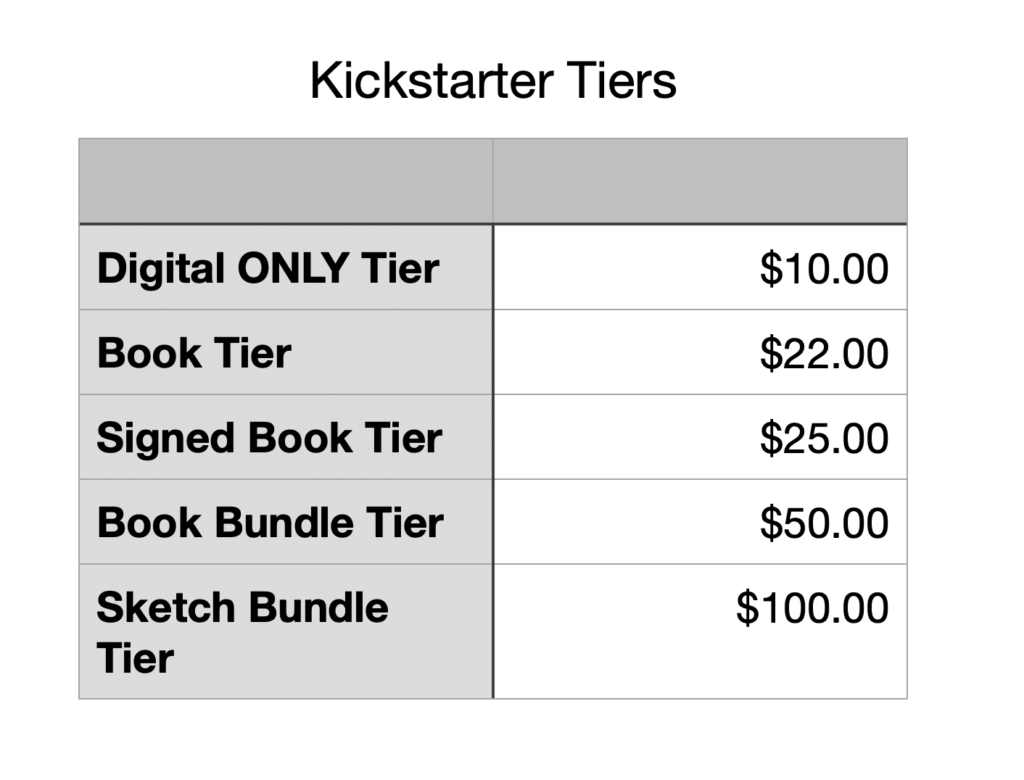
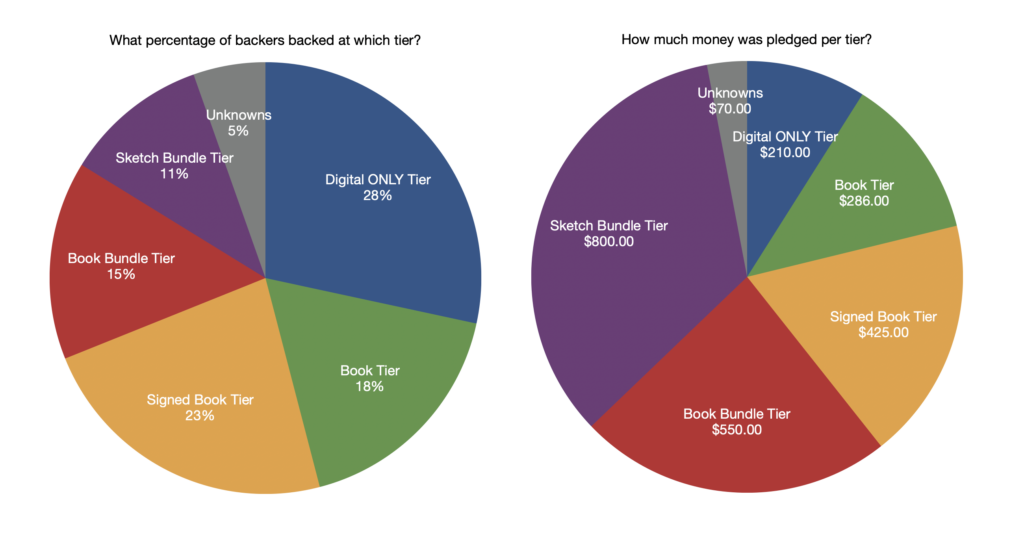
And here is the breakdown of backers per tier as well as the dollar amount received from each tier groups’ backing.
Text Summary for accessibility:
The left pie chart shows the percentage of backers per rewards tier. From the top going clockwise: Digital ONLY tier = 28%. Book Tier = 18%. Signed Book Tier = 23%. Book Bundle Tier = 15%. Sketch Bundle Tier = 11%. Unknowns = 5%.
The right pie chart shows how much money was pledged per rewards tier: From the top going clockwise: Digital only tier = $210. Book Tier = $286. Signed Book Tier = $425. Book Bundle Tier = $550. Sketch Bundle Tier = $800, Unknowns = $70.
The “Sketch Bundle Tier” was a bundle of past works and a custom Posca Marker sketch, limited to 8 pledges allowed (in order to keep the custom sketch count manageable for me) and priced at $100. This was fully sold out and contributed to the largest chunk of the total.
The “Book Bundle Tier” was priced at $50 and had a limited supply of 14, simply due to the quantity of past books I had left. I had 3 left at the end of the campaign.
The rest is self-explanatory.
So who showed up?
With Kickstarter and other crowdfunding platforms, I learned quickly that you can’t rely on discovery. You have to bring your own audience. So how do you do that when you don’t have a social media following?
Family, friends, and the people who know you in real life.
Unless you’ve been living under a rock, there are people in your life who want to see you succeed.
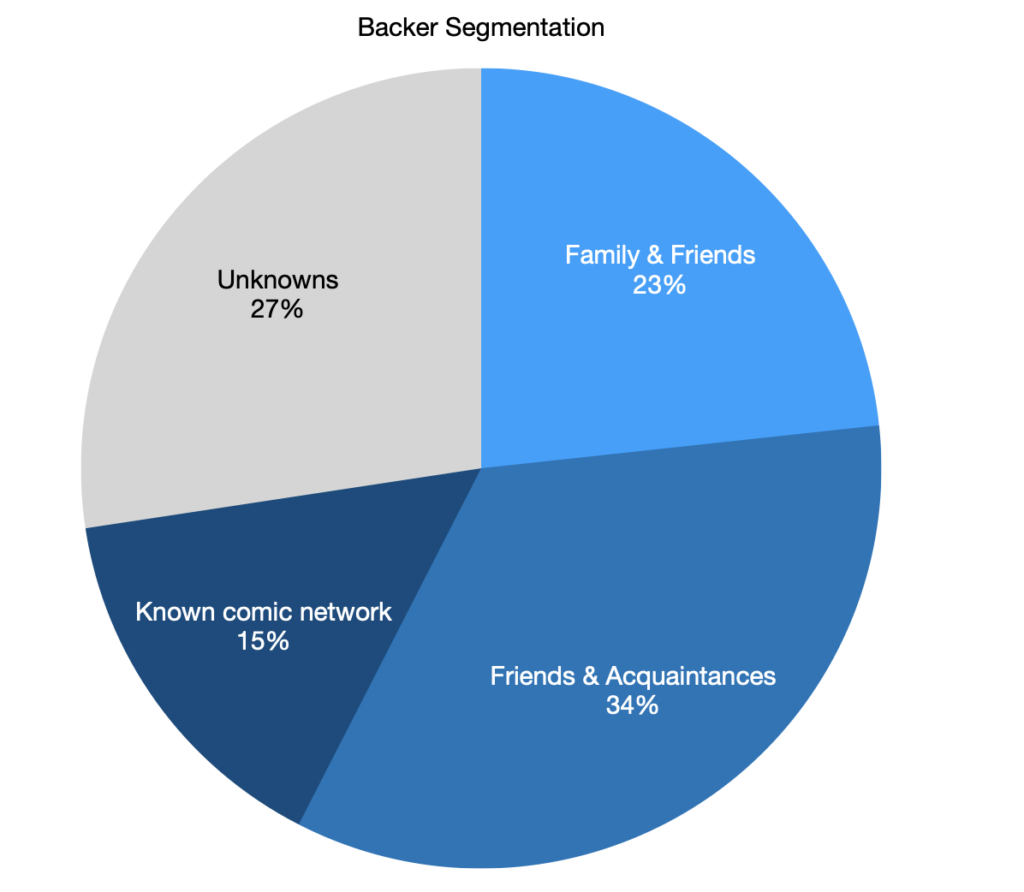
Of my backers, over half were people I already knew in real life. Some I was in active communication with from childhood and into my adulthood. Others were friends that had grown distance over the years and resurfaced through the social outreach I had been doing throughout this campaign. Adding the people that were found through the comics community, almost 70% of my backers were known people!
What’s more significant is the monetary breakdown:
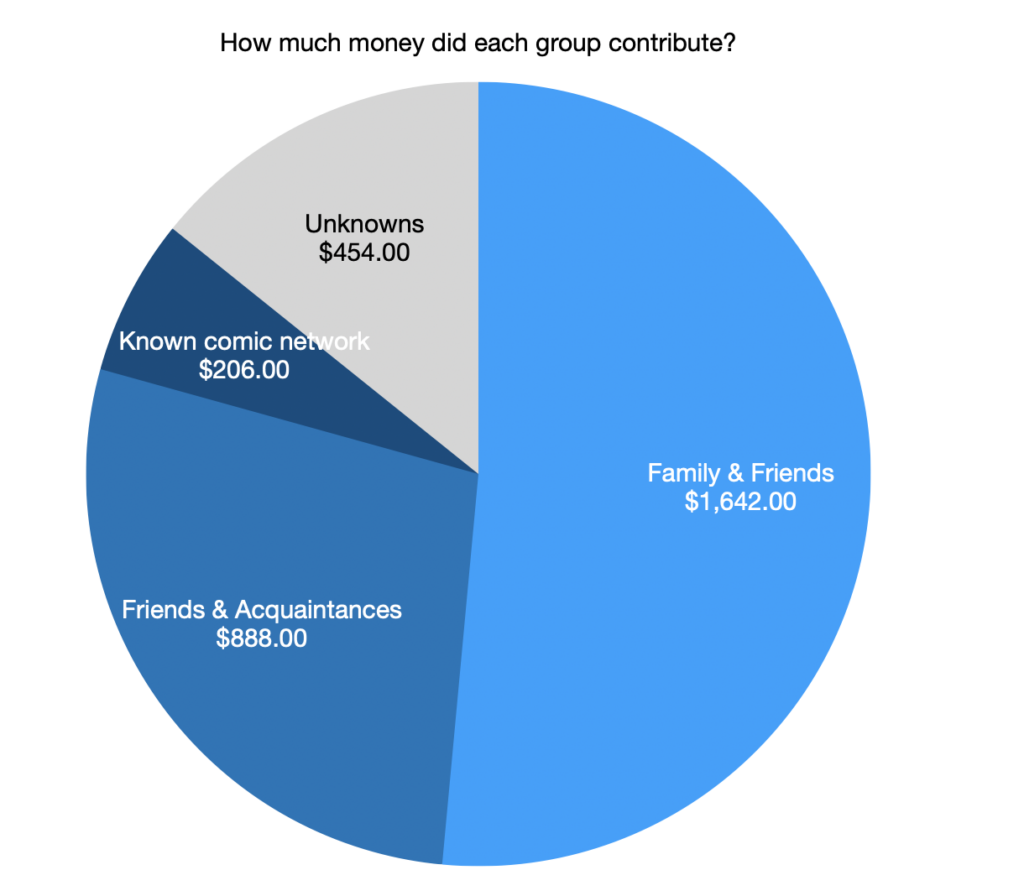
Family and friends overwhelmingly contributed the most funds. They alone reached the funding goal in the 1st 24 hrs and overall selected the higher reward tiers. Pretty much all the Sketch Bundles, the highest-priced tier, were taken by people I knew IRL.
Discovery backers (the unknowns… most likely the people who found me through social media posting or the Kickstarter ecosystem) were a mix of reward tiers, though a large chunk of them favored the lowest digital tier. Discovery backers contributed the most to the end-of-campaign surge, though a near-equal percentage came from a combined grouping of friends, family, and known networks.
Text summary for accessibility
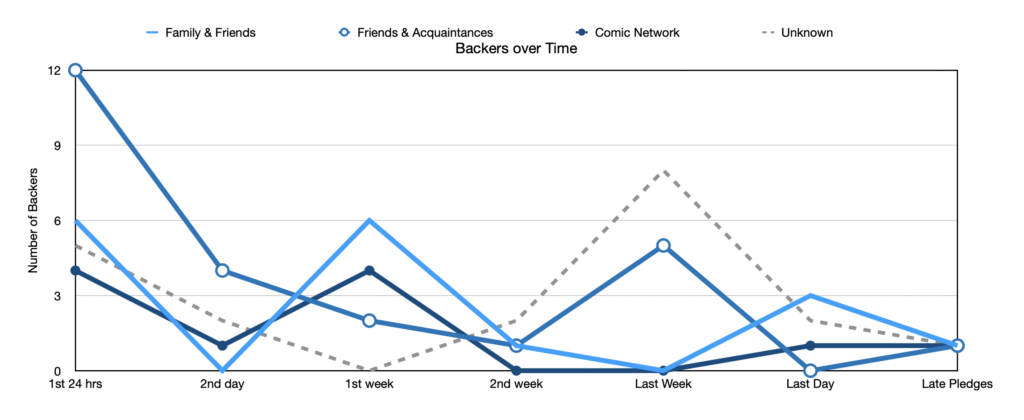
Line graph of Backers over time.
- Family and Friends: 1st 24 hrs = 6 backers. 2nd day = 0. 1st week = 6. 2nd week = 1. Last week = 0. Last day = 3. Late pledges = 1.
- Friends and acquaintances: 1st 24 hrs = 12 backers. 2nd day = 4. 1st week = 2. 2nd week = 1. Last week = 5. Last day = 0. Late pledges = 1.
- Comics network: 1st 24 hrs = 4 backers. 2nd day = 1. 1st week = 4. 2nd week = 0. Last week = 0. Last day = 1. Late pledges = 1.
- Unknowns: 1st 24 hrs = 5 backers. 2nd day = 2. 1st week = 0. 2nd week = 2. Last week = 8. Last day = 2. Late pledges = 1.
The honest conclusion:
My Kickstarter succeeded through a mix of people who knew me from my in-person life, a found comics community, and yes, even unknown discovery backers. You don’t need a massive following. You need people who trust you, in whatever context that exists.
For me, that was friends, family, old social networks that retained connection through Facebook and LinkedIn.
A final note:
It would be remiss of me to not mention an important detail: people come from all sorts of situations. Do NOT hold it against anyone for not backing your crowdfund. Some people don’t have the funds. Some people don’t like digital purchasing. Some people can’t figure out the account creation. Some people just forget. There are many reasons behind why and that’s okay. You’ll have your moment too, so don’t hold it against anyone.