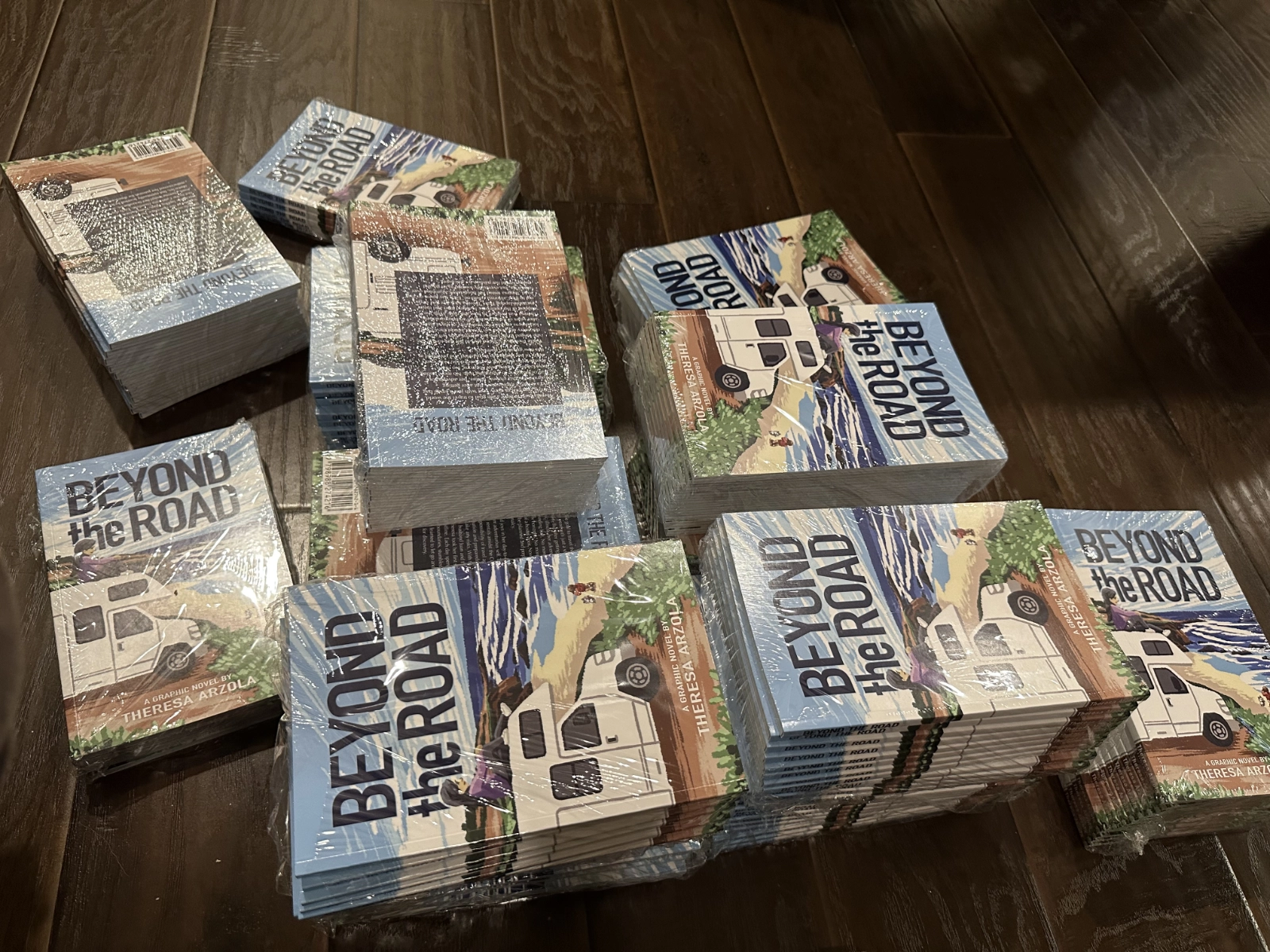
It’s been awhile since my last real blog post and it’s primarily been due to me being heads down in Beyond the Road work! But we did it! The book has been finished, the Kickstarter was launched, successfully funded, and now… I have books!
Now at the tail end of this long project, I wanted to share a sort of “post-mortem”, a structured reflection of the past months in order to inform next steps and share the lessons learned. Maybe it will help another small-scale comic creator looking to Kickstart their graphic novel? If anything, I hope it’s a little insightful.
But first…
What is Beyond the Road?
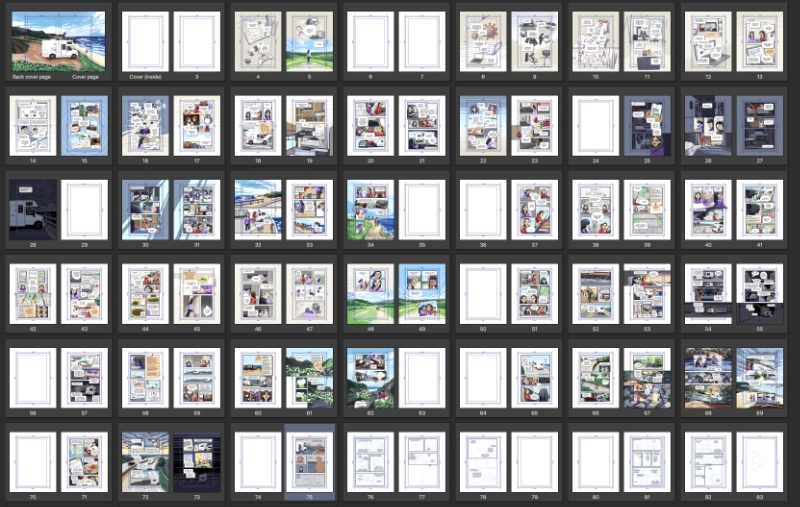
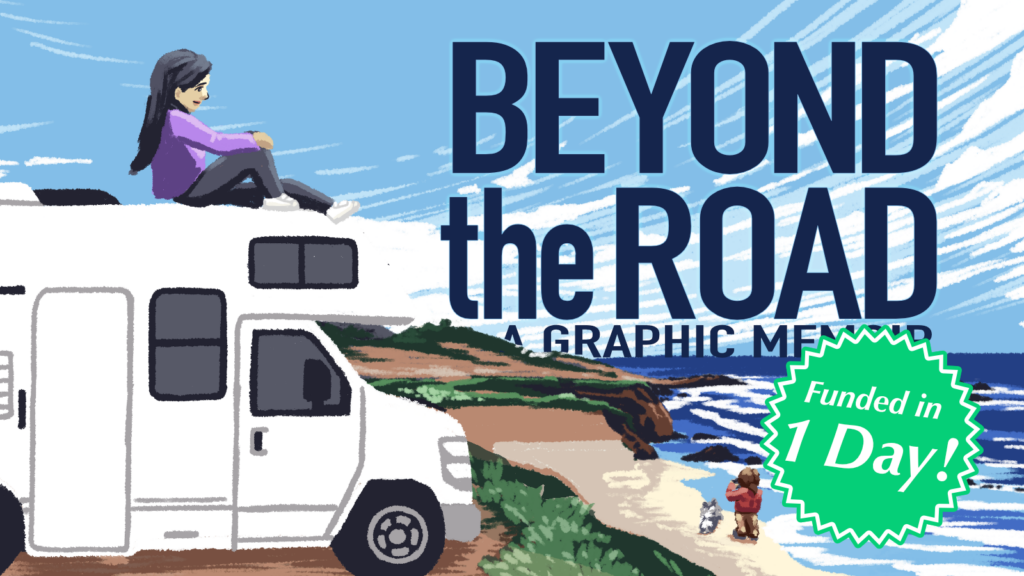
Beyond the Road is my first full-color graphic novel memoir — a 110-page, true story comic about rediscovering adventure with chronic illness, told through a 4-day RV trip down the Big Sur coast. I spent a year drawing and 3 months launching, running, and fulfilling a successful Kickstarter, which can see be seen on the Kickstarter’s campaign page.
The General Timeline of It All
Early 2024
I decided I wanted to focus on creating a complete graphic novel and chose this true story because it had a hopeful message I wanted to share, even if I was hesitant about being more opening about my health issues.
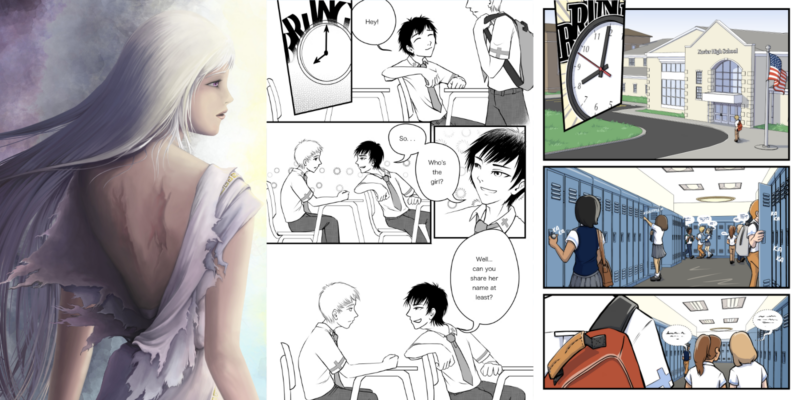
At the time, I actually wanted to work on 3 comics at the same time: Adventures with Titan, Beyond the Road, and Angel Chronicles… but soon learned how unfeasible that was and ultimately chose to focus on Beyond the Road because of its shorter production timespan. I still worked on Adventures with Titan though, since the episodes were simple and only came out once a week. It ended up serving as nice breaks in between the more serious long-form work of a graphic memoir.
Mid 2024
Following the advice of some rather talented graphic novelists, I created a pitch deck and sample chapter, then went around cold pitching to as many agents as I could. Finding agents in the “graphic novel memoir” space is a difficult and time-consuming process. As far as literary agent querying tools are concerned, graphic novels = middle grade. And memoir ≠ comics. So finding agents that align to both meant reading website bios and writing unique query letters. Then waiting in the 3-week silence in the hopes of hearing back.
Because agent querying requires a lot of waiting, I ended up spending the time getting educated about the publishing process and after learning how lengthy the road can be, I decided to just… do it myself.
Early 2025
I picked the self-publishing route and started drawing the pages as soon as that decision was made. There were other life obligations during that time, but by the end of 2025, I had gone through the whole comic-creation process (drawing, editing, reviewing, compiling, etc) and was ready to print & distribute.
Late 2025
After a lot of research, I decided to go the Kickstarter route. There were many factors that led to that decision but the ultimate one was the framing my husband gave me. Kickstarter would mean a time-boxed period of marketing. 3 months of sharing, networking, and promoting. After that time-box, I’m free.
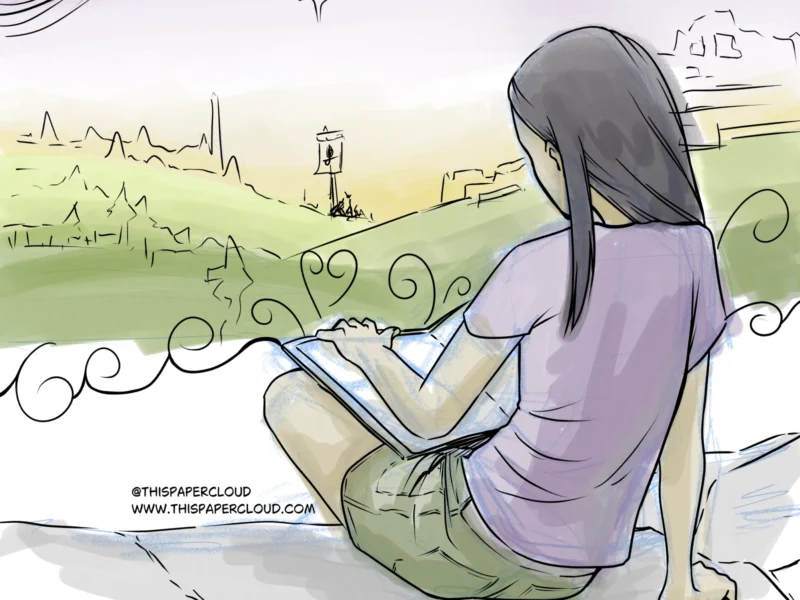
As someone who is not a fan of routinely posting on social media, as an artist that would much rather continue to sit in her studio drawing and creating rather than marketing and promoting… the timebox sold me.
Early 2026
I launched a Kickstarter, which sounds a lot simpler than it was. It ran for 3 weeks and raised $3195 for Beyond the Road’s first print run!
Post Mortem: What Went Well
- Book completion: The most obvious of the successes, I completely wrote, drew, and compiled a 110-page full-color graphic novel… in a year!
- Successful Kickstarter: It fully funded in 24 hours and finished at 214% of its funding goal. 74 backers at $3195 ($1695 above its target).
- Newly discovered creator network: I met a lot of really wonderful comic creators and industry professionals during this period and I’m so grateful for their support and advice. These aren’t people to just promote at. They’re a genuine network of enthusiasts to stay connected to in this world of comic creation, which I plan to continue to keep syncing up with.
- Positive Reviews: I started to receive several positive reviews once the books shipped out. From friends and family to others in my new comic community network, the unsolicited compliments were especially a highlight in this whole experience.
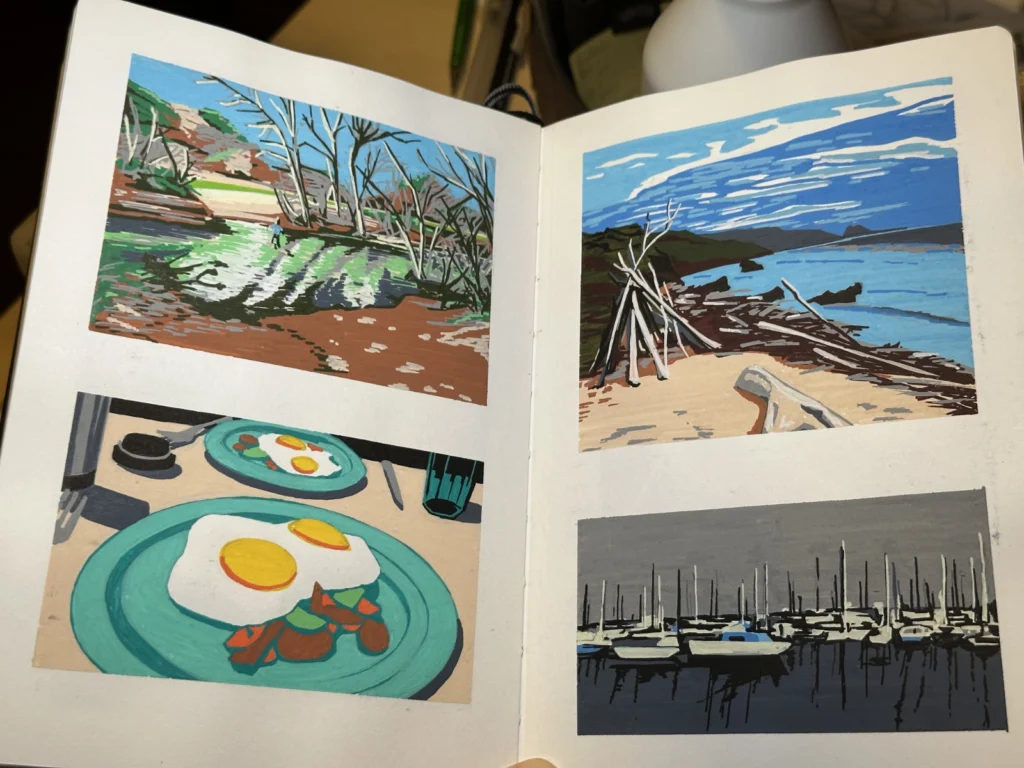
- Simple painterly art style: I chose Beyond the Road’s art style due to the Posca marker paintings I did during the road trip and the iconic National Parks posters’ design. As an artist, I like to match the style I work in to the subject and the flat painterly brush with bold colors I chose for Beyond the Road created impressive scenic page spreads while also not being that difficult to draw. This was one of the main factors that enabled me to finish a whole graphic novel in just a year.
What Didn’t Go Well
- Kickstarter’s Pledge Manager Failed: At the time I ran my campaign, Kickstarter was promoting their Pledge Manager, a tool that helps manage the details of pledge fulfillment, including tax and shipping fees. There were a lot of caveats to using it, including requiring I allow it to collect the shipping fees at the end of the campaign instead of during the user’s pledge action. I obliged because… I wanted the help!
It turned out that despite doing what it said was required, Pledge Manager was never enabled for me, leaving me to figure out fulfillment myself (and shipping fees… because it never collected those!). Thankfully… I had several generous backers who donated to help support those unexpected costs. But I would have preferred to not have had to ask! - Lack of timely customer support: On the same subject, Kickstarter’s customer support was so slow it might as well have been non-existent. I did hear that the company had a big layoff in the middle of my campaign period, so that might have influenced things. But when things started to break or bug out, I had no one to turn to. Especially with the Pledge Manager issue, I was met with radio silence for weeks.
- Too many 3rd party service sellers: The 3rd party Kickstarter ecosystem is flooded to the point of unusable. Educational sources are hard to find because there’s so much Search-Engine-Optimized pages designed to convince you their 3rd party system or tool or consulting service is the only way you won’t fall flat on your face if you try to run a Kickstarter. Even asking an AI for advice returns inconsistent answers (I don’t generally recommend AI, but sometimes when search engines fail me, I will turn to it like a glorified google search. It can still fail like a search engine though). Asking Kickstarter communities often resulted in the “hustle-y” bro types just telling me “you’re wrong” without providing legitimate help. When you’re small-scale, it’s a lot harder to find the useful resources.
- Drawing comics is isolating: Drawing is, for the most part, a solitary activity and I love it. But drawing 110 pages can be very isolating. Having some sort of feedback loop, a “comic creators circle”, would have been useful.
Post Mortem: Lessons Learned
- Don’t use Pledge Manager. It’s finicky and gets disabled really quickly. And it’s ultimately not a great user experience for the customer since it feels like getting a surprise charge at the end of the campaign, rather than knowing what you’ll be paying up front. There’s no benefit to use it, at least not as a small scale comic creator. When small scale, just use spreadsheets. And if larger scale, try something like Backer Kit, which seems universally recommended (at the time of this writing).
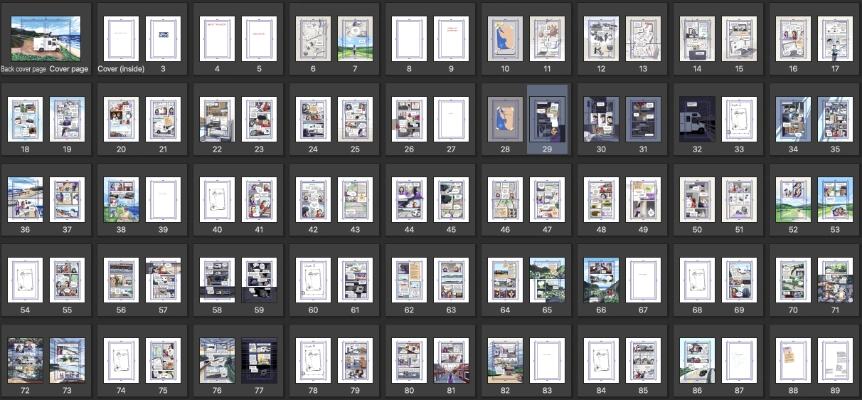
- Track your progress. I went into this project thinking I could just use Clip Studio’s book view to visually track progress, but when working on anything long term, it’s really valuable to have something to mark and indicate completion so you get a sense of not just how far you have left to go, but how far you’ve gone already. Comic creation can be pretty isolating, so in addition to have a community to talk to, a progress tracker can help keep you sane through the process.
- Network authentically. There’s a community of indie comic creators and comic genre niches hiding just behind the algorithm. You can find them if you step out there and say hello. The internet might be full of competition and angry voices, but there are some truly wonderful and supportive people in the world.
- I will especially call out Fanbase Press. They’re nurturing a really solid network and supportive community.
- Kickstarter is not for discovery. Majority of your backers will be people you bring from your personal network or your fanbase. If you’re small, it will likely be your personal network that comes out to support. That’s not to say you can’t get some discovery on Kickstarter! Just don’t rely on it. There is a community around small-sized comic Kickstarter campaigns, but if you’re new to the scene, expect hesitation unless you network.
- Also from a purely numbers perspective, those “cold backers” will be most likely backing at the lowest tier possible. The majority of your funds will be coming from people who know you.
Next Steps?
Beyond the Road is over (almost) and I won’t be doing another Kickstarter for awhile (would need to have a new book first). The goal with this post is just to record the experience and lessons learned, in case it helps someone else looking to create a small-scale self-published comic and raise funds.
For the rest of this year, I’ll be tabling at events around the Bay Area, selling my extra copies of Beyond the Road at zine fests and comic cons and consignment. Wherever I can. You can see upcoming events on my website, or by following me on Instagram or Bluesky.
I’ll also be setting up Beyond the Road to be available via Ingram and Amazon through their printing services. This will make it more easily available to indie book stores and long distance individuals. I’ll also be figuring out digital download distribution so anyone not wanting a physical copy can get it that way too.
And finally, I’ll be starting my next project soon, which will be Angel Chronicles! I’ll share more about that in the coming weeks.